

Austria and Denmark want to open eviction camps on the outskirts of the EU
According to the Danish Prime Minister, Copenhagen is in discussion with Vienna and "other countries" of the Union for the establishment of a "new European asylum system".
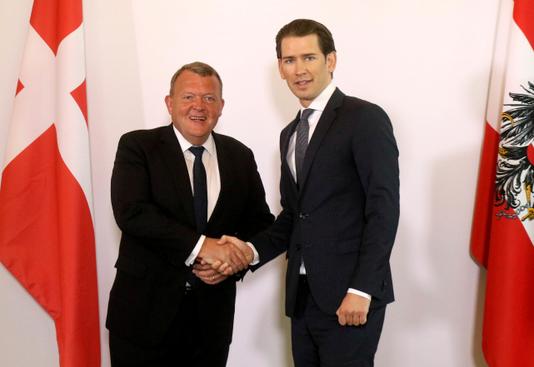
Their divisions and the pressure of the populists are definitely creating the most stunning ideas among European leaders regarding the treatment of asylum seekers and the refoulement of those who have been rejected.
On Tuesday, 5 June, Danish Prime Minister Lars Lokke Rasmussen announced that his country is in discussion with Austria - which will soon assume the rotating presidency of the Union - and "other countries" for the establishment of 'a new European asylum system'. Central point of the device: the creation of "common centers of reception and expulsion in Europe", but outside the territory of the EU it seems. Clearly, detention camps, where there would be migrants who can not claim asylum, or can not be quickly returned.
Mr. Rasmussen did not mention the possible location of these camps. According to him, they would not be "on the list of favorite destinations for migrants and smugglers". In fact, according to several sources, Albania and Kosovo are candidates for EU membership. The prime minister mentioned contacts "with other European leaders" and said he was "optimistic" about setting up a pilot project "by the end of the year". The idea of opening camps in European countries, outside the EU, is also carried by the Austrian Minister of the Interior, Herbert Kickl, heavyweight of the FPÖ (far right) in the ruling coalition in Vienna. The first talks would have taken place in Sofia on the sidelines of the summit between the Twenty-Eight and five countries of the Western Balkans on 17 May.
"Practical and legal challenges"
The Social Democrats and populists of the Danish People's Party (Dansk Folkeparti, DF) - the latter support Mr Rasmussen in Parliament without participating in the government - have expressed their support for the Liberal Prime Minister's proposal. The populist formation had already proposed to transform an uninhabited island of the kingdom, located outside the territory of the Union, into a detention center for the rejected. Liberal Immigration Minister Inger Stojberg responded that she was "always ready to look at good ideas", even though it presented "practical and legal challenges".
Visiting Brussels on Wednesday, Austrian Conservative Chancellor Sebastian Kurz presented the main thrusts of his EU presidency, which will start on 1 July. He would have liked all the attention to be paid to his two priorities: the strengthening of the Union's external borders and his proposals for the post-Brexit budget. Asked what Mr Rasmussen said, he had to confirm them, while cautiously adding that it was not a project carried by his future presidency but "an initiative from a small circle to which the Denmark belonged. Which other Member States would be affected?
The Netherlands, it seems, but the Dutch diplomacy said Thursday, not wanting to comment on the implementation of the project. Belgium would not have been consulted even if, on Monday, at a meeting of the European ministers of the interior and migration, his secretary of state, the Flemish nationalist Theo Francken, had mentioned the need to prevent the boat berthing in Europe - "push back" - and proclaimed "the death" of the Dublin Regulation, which obliges the countries of first arrival (Italy and Greece especially) to register a migrant before its possible transfer to another Member State.
Germany would have been "approached" but a close friend of Chancellor Merkel did not hide her skepticism. As for France, it seems to be naked. Paris is working on a text to get the migration file out of the rut but could not accept the idea of detention camps. "Unimaginable," said a diplomatic source, "to see the Balkan countries join in such initiatives, even in exchange for financial support or an acceleration of the examination of their membership.
Brussels worries about drifts
The European Commission is embarrassed. It considers the projects in question to be "national initiatives", stressing that it would be better to have a European approach, based on the "values" of the Union. Previous projects aimed at the creation of "reception" centers, especially in Libya, had been cautiously discarded.
Brussels is particularly worried about the excesses of the debate and fears the multiplication of incidents with the future Austrian presidency, likely to rally the voices of Hungary, Poland or other member states, hostile to the reception of asylum seekers . Herbert Kickl announced that his country would no longer participate, like most countries in the Visegrad group, in the distribution program for refugees arriving in Greece and Italy. He hopes that no longer any asylum application will be studied on European soil.
